
How VoIP Works, in 3 Points
There are three different ways to make a VoIP call. Each of these ways has its own requirements and implications.

VoIP, or Voice over Internet Protocol, is a technology that converts analog audio signals into digital data and transmits them over the internet. Driven by innovation, VoIP has completely reinvented the world's phone systems. VoIP has turned the standard internet connection into a way to make phone calls at a lower cost. Compared with traditional phone systems, VoIP offers many advantages.
Of all VoIP's features, the most attractive is the savings that come from lower communication costs. Before VoIP, standard phone systems charged heavily for long-distance calls. VoIP lets businesses move away from public switched telephone networks. This is possible because voice traffic travels over the internet or over private data network lines.
Along the same lines, another VoIP advantage is lower costs for equipment, lines, maintenance and labor. Because VoIP carries its voice and data traffic over a single physical network, businesses no longer need separate PBX trunk lines. Although there is an initial setup cost, VoIP saves businesses a great deal by consolidating voice lines onto a single network. This lets them do away with the need to maintain a legacy phone system. With the company's voice and data networks now managed on one network, the workload of network administrators becomes lighter.
VoIP makes your phone numbers portable. With standard phone systems, a phone number is assigned to a dedicated line. So if you want to move your phone to another location, you have to change your phone number because you can no longer use the old one. The big advantage VoIP gives you is mobility. With mobility, you can use the same number from your phone wherever you are. All your phone needs is the appropriate IP connectivity. Businesses that have built VoIP into their communications can therefore use their IP phone or softphone even when traveling, while keeping the same number. VoIP also lets them enjoy the same services on the move. This means that wherever their phone is, they still benefit from VoIP services such as voicemail access, call logs, service policies, security features and much more.
VoIP can integrate and connect multiple applications such as email, the web browser, instant messaging, social networks and more. This unification makes employees more productive and gives them a better working setup, especially since they can receive voicemail directly in their inbox. Phone numbers are also dialed faster and more accurately thanks to click-to-call services on websites. VoIP also supports a voice call button in emails, along with presence information on a contact list.
VoIP also gives users a graphical user interface that makes it easier to view and browse evolving features, options and services. With the tools and solutions VoIP provides, a user can change a call forwarding number, a speed dial number, presence information, music-on-hold options, anonymous call blocking and much more, right from the website.
With VoIP, you also no longer need an area code or country code for a specific location. VoIP virtually eliminates geographic boundaries. So if you subscribe to a phone number in another country, calls to that country become national calls and therefore much simpler.
In short, VoIP unified communications solutions let businesses take advantage of features such as Find-Me-Follow-Me, custom ringtones, call-enabled websites, selective call forwarding, selective area or country codes, and simultaneous ringing on multiple phones.
There are three different ways to make a VoIP call. Each of these ways has its own requirements and implications.
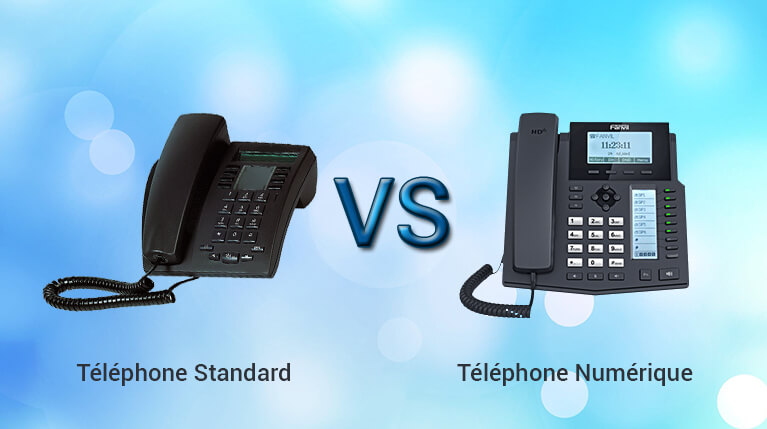
Traditional telephony is increasingly being replaced by IP telephony.

One of the challenges businesses often face is the high cost of their phone bills.
Tell us about your project: we will propose the right solution, on-site or in the cloud.